How to Stop Doomscrolling

You pick up your phone for “just five minutes.”
Maybe you want to check one message, read one article, or see what happened online. But somehow, thirty minutes disappear. You are still scrolling, even though you are no longer enjoying what you are seeing.
This is doomscrolling.
It is the habit of continuously consuming negative, stressful, or emotionally stimulating content online — often long after you intended to stop. Many people experience it late at night, during work breaks, or whenever they feel bored or mentally tired.
The frustrating part is that most people already know doomscrolling is hurting their focus. They know they should put the phone down. They know they would feel better after going for a walk, reading a book, or finishing an important task.
Yet they keep scrolling.
That is because doomscrolling is not simply a problem of willpower. It is a problem of habits, environment, and how our brains respond to endless digital stimulation.
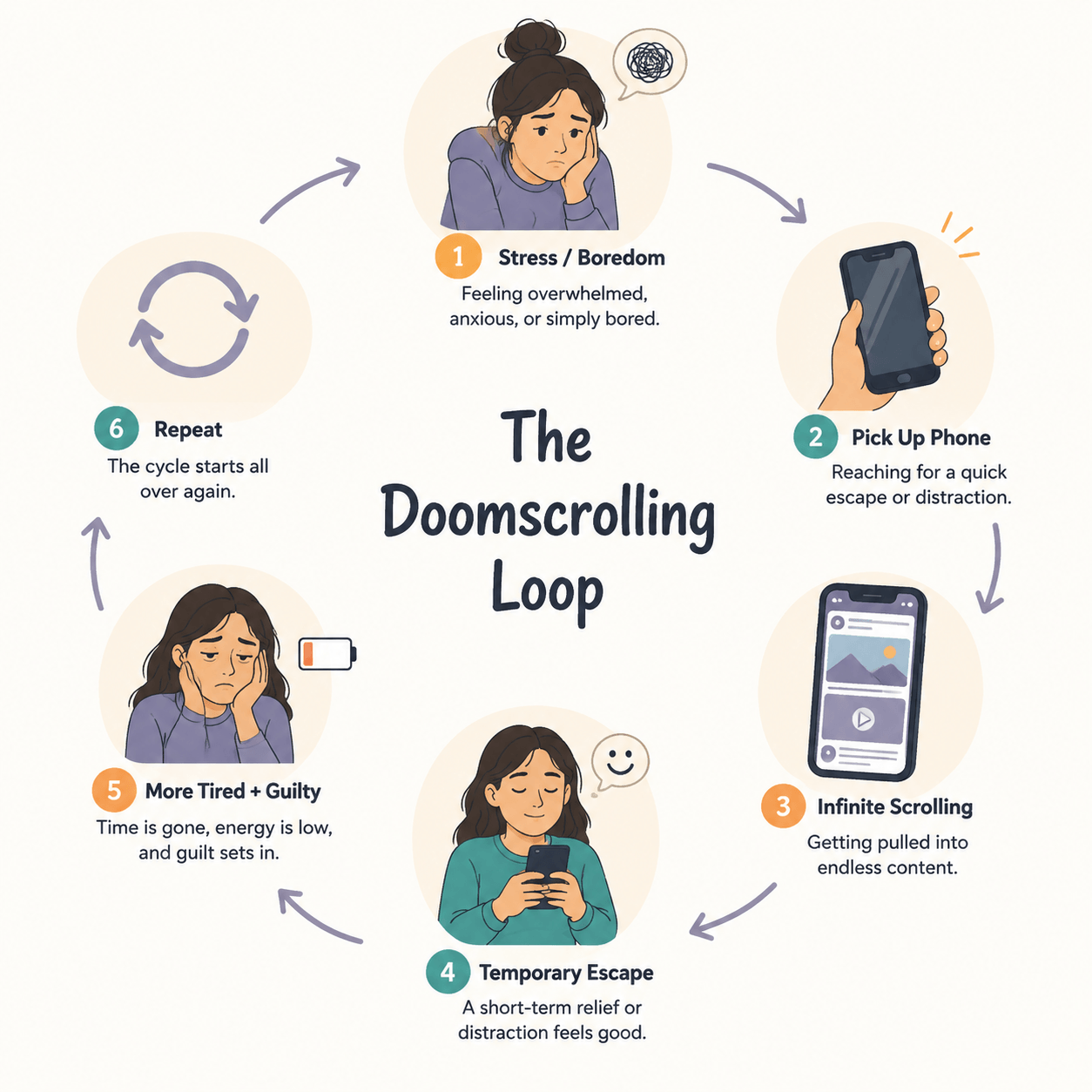
Learning how to stop doomscrolling requires more than deleting an app or promising yourself to “be more disciplined.” It requires understanding why the habit exists and building a system that makes healthier choices easier.
Why Doomscrolling Is So Difficult to Stop
Many people blame themselves for lacking discipline when they cannot control their screen time.
But the reality is more complicated.
Modern apps are designed around attention. Infinite scrolling, notifications, personalized recommendations, and constantly changing content all encourage users to stay engaged.
The problem is not that people are weak. The problem is that they are fighting against a carefully designed environment.
Imagine trying to eat healthier while keeping a kitchen full of your favorite snacks. You might succeed occasionally through discipline, but eventually, your environment makes the decision harder than it needs to be.
Your phone works the same way.
Every time you unlock your screen, you enter an environment designed to offer immediate stimulation. Compared with activities like exercising, studying, or working on a long-term goal, scrolling requires almost no effort.
The brain naturally prefers the easier option.
Understand Your Doomscrolling Triggers
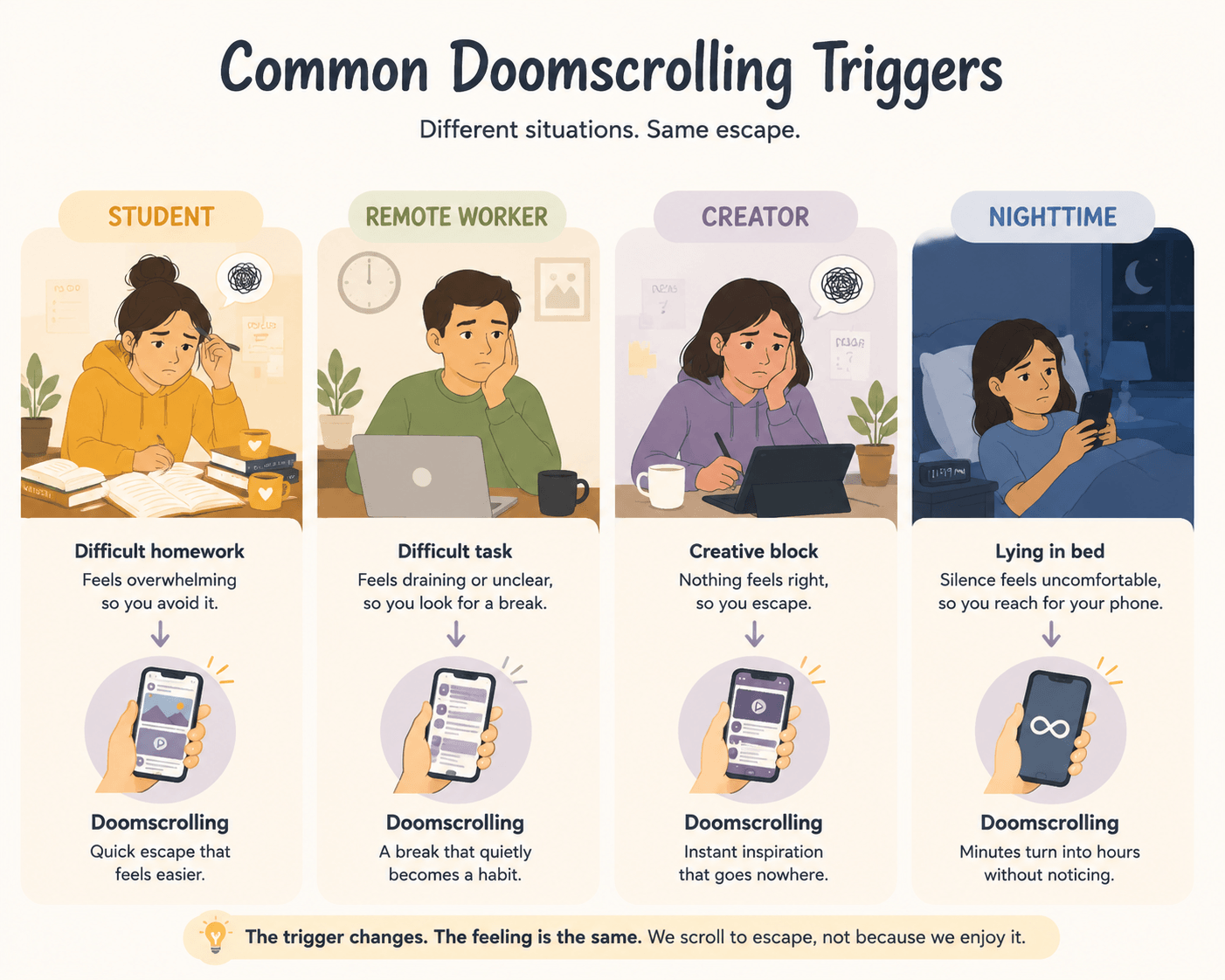
Before trying to stop doomscrolling, pay attention to when it happens.
Most people have predictable patterns.
For example:
- A student scrolls social media whenever homework feels difficult.
- A remote worker checks news feeds every time a task becomes uncomfortable.
- A creator spends an hour watching videos because they feel stuck on a project.
- Someone scrolls in bed because silence feels uncomfortable.
The phone is often not the real problem.
The phone is a coping mechanism.
Doomscrolling usually appears when we experience emotions like:
- boredom
- stress
- uncertainty
- loneliness
- mental fatigue
- avoidance
Instead of asking:
“Why can’t I control my phone?”
Try asking:
“What feeling am I trying to avoid right now?”
That question changes everything.
If you discover that you always scroll when a task feels overwhelming, the solution is not simply removing the app. The solution is learning how to handle discomfort without escaping into your phone.
Create Friction Between You and Distracting Apps
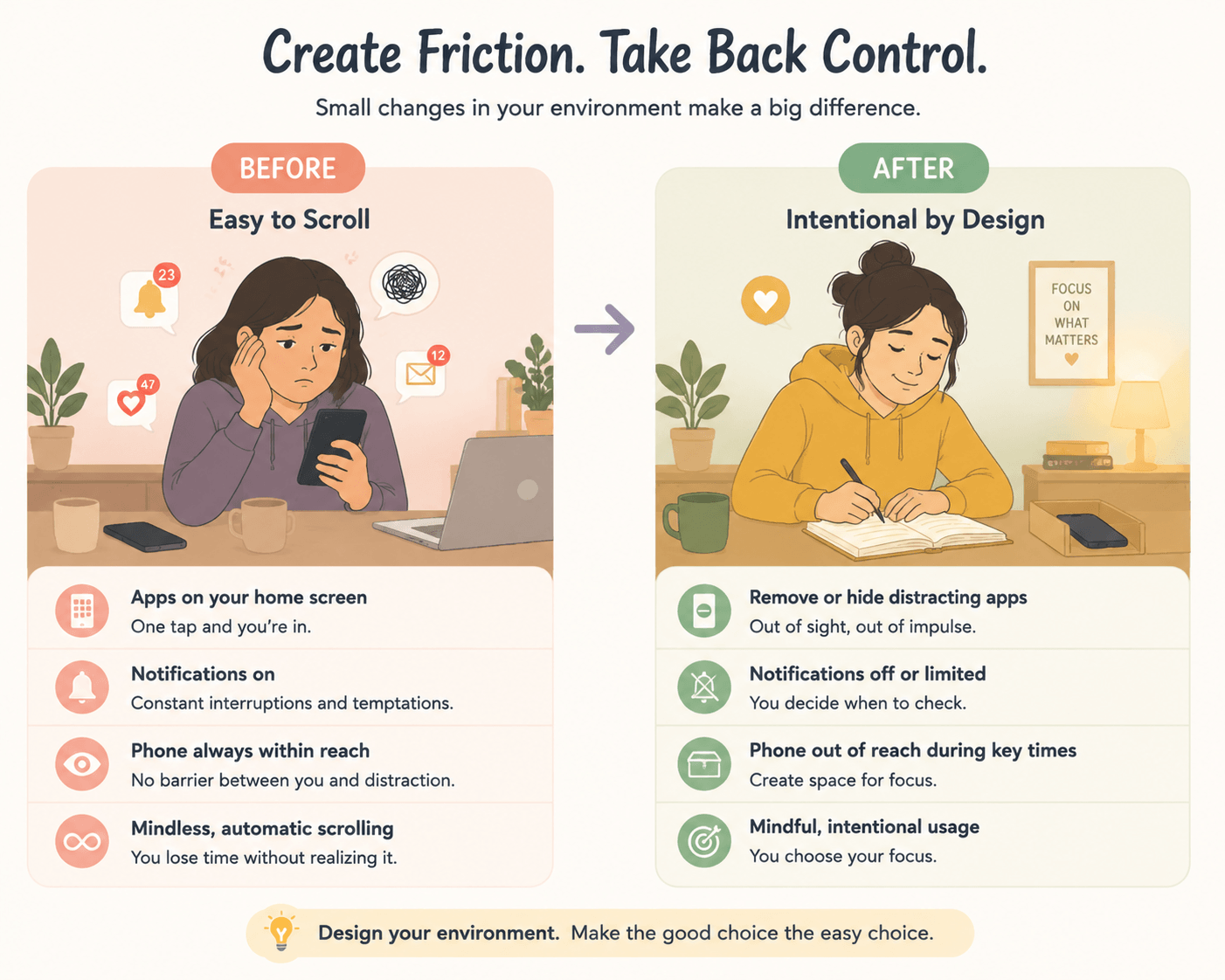
One of the most effective ways to stop doomscrolling is to make the habit slightly harder.
Small amounts of friction can completely change behavior.
For example:
- Remove social media apps from your home screen.
- Log out after each session.
- Disable unnecessary notifications.
- Keep your phone outside your bedroom.
- Use app limits during your most vulnerable hours.
These actions seem simple, but they create a moment of awareness.
When opening an app requires extra steps, your automatic behavior becomes a conscious decision.
That pause gives you a chance to ask:
“Is this actually what I want to do right now?”
The goal is not to eliminate technology. The goal is to stop using it unconsciously.
Replace Doomscrolling With a Better Default Habit
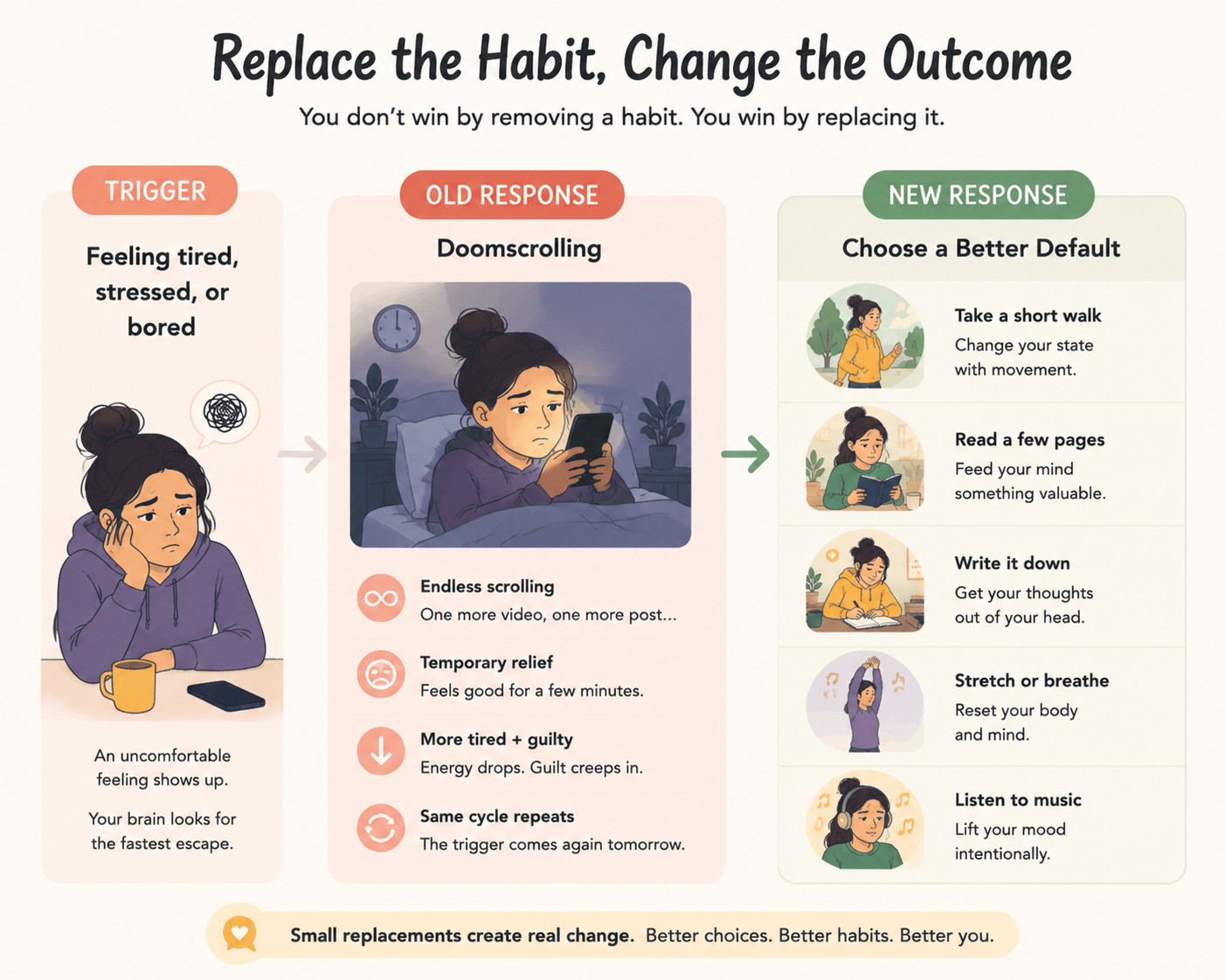
A common mistake people make is trying to remove a bad habit without replacing it.
If you simply delete social media apps, you may eventually reinstall them because the underlying need is still there.
Your brain needs something to do during those moments.
Instead of scrolling, prepare alternative actions:
- Read a few pages of a book.
- Take a short walk.
- Write down your thoughts.
- Stretch for five minutes.
- Listen to music.
- Review your daily priorities.
The replacement habit does not need to be impressive.
It only needs to be easier than doing nothing.
A person who replaces ten minutes of scrolling with ten minutes of journaling is already changing their identity. They are becoming someone who chooses intentional actions over automatic consumption.
Build a Daily Structure That Reduces Decision Fatigue
Many people struggle with doomscrolling because their day has no clear boundaries.
When there is no plan, every moment becomes a decision:
Should I work?
Should I rest?
Should I check my phone?
Should I start that project?
Too many decisions create mental exhaustion.
A simple routine can reduce this problem.
For example:
Morning
- Avoid social media for the first 30 minutes.
- Decide the most important task of the day.
Work hours
- Schedule focused work blocks.
- Keep distracting apps unavailable during deep work.
Evening
- Create a clear shutdown routine.
- Avoid endless scrolling before sleep.
The goal is not to create a perfect schedule.
The goal is to remove unnecessary moments where your brain has to negotiate with temptation.
Focus on Becoming Someone Who Keeps Promises
Many people approach self-improvement as a battle against themselves.
They say:
“I need more discipline.”
“I need more motivation.”
“I need stronger willpower.”
But discipline is not built through constant self-criticism.
It is built through keeping small promises repeatedly.
If you promise yourself you will spend less time on your phone, start with something realistic.
Instead of:
“I will never waste time scrolling again.”
Try:
“I will keep my phone away during breakfast.”
Or:
“I will spend the first 20 minutes of my morning without checking notifications.”
Small promises build trust with yourself.
Over time, you stop seeing yourself as someone who always gives in. You become someone who follows through.
Some people find it helpful to use supportive systems that focus on consistency rather than punishment. For example, a discipline companion like Mom Clock approaches routines and personal growth by helping people stay aware of their commitments and build better daily patterns.
The important part is not the tool itself. The important part is creating a relationship with your habits where you are guided, not constantly fighting yourself.
Make Your Phone Work For You, Not Against You
The goal of stopping doomscrolling is not to hate technology.
Phones are incredibly useful. They help us learn, communicate, create, and stay connected.
The problem happens when entertainment becomes the default response to every uncomfortable moment.
A healthier relationship with technology means deciding:
- When will I use my phone?
- Why am I using it?
- Is it helping the person I want to become?
A phone should be a tool you control, not a habit that controls you.
Progress Matters More Than Perfection
You will probably still doomscroll sometimes.
Everyone does.
The goal is not to become someone who never wastes time. The goal is to become someone who notices faster and returns to what matters.
Maybe today you spend two hours scrolling.
Tomorrow, you notice after thirty minutes.
Next week, you catch yourself after five minutes.
That is progress.
Changing habits is not about one perfect decision. It is about thousands of small choices that slowly reshape your behavior.
The question is not:
“How do I become perfectly disciplined?”
A better question is:
“What is one small promise I can keep today?”
That is how lasting change begins.